Showing posts with label photojournalist. Show all posts

Trading to Extinction ~ By Photojournalist Patrick Brown

Patrick Brown has been awarded a prize in the World Press Photo contest and the prestige’s 3ppp award for his work on the trafficking of poached animals in Asia. From the pristine jungles of Cambodia to the great national parks of India and Nepal, Asian wildlife is being plundered on an unprecedented scale.

Day by day, hour by hour, our planet`s rarest creatures are being hunted, trapped and slaughtered to feed a global black market in wildlife products.  Patrick has worked on this project for 10 years in an attempt to expose that trade.

Every year, some 30,000 primates, two-to-five million birds, and ten million reptile skins enter the Asian wild animal market, the third-largest illegal smuggling operation in the world.

In cultures where tiger skins, rhino horns, and bear bile are imbued with mythical properties, these wild animal parts are bought and paid for at astonishingly high prices. In Black Market, we come to understand that the price for these rarities may be the very survival of endangered species world-wide, as well as the ecological stability of the planet.

Support Patrick's book and find out more about Patrick Brown’s project by visiting his Emphas.is page


Thai poacher in cuffs. Score one for the good guys!


VICE visits Patrick Brown in Bangkok to talk about the craft of photography and his forthcoming book, Trading to Extinction, which documents the illegal trade of endangered animals in Asia. We then travel with Brown to Guangzhou, China, where he finishes his decade-long project.


The sale of bear paws, crocodile hearts, and other rare animal parts form the world's third-largest illegal market. Black Market explores the human passions and ancient beliefs that drive the trade and threaten its most endangered species. See the project at http://mediastorm.com/publication/black-market


Photographer Profile ~Adam Hinton


Photographer Adam Hinton's Bio:
I began my photographic career at the age of 12 when my dad bought me a basic SLR camera. I became fascinated with a new way of looking at the world and the ability to record things of importance to me. It was a way of marking out my world.

When I was 15, I received the first installment of compensation from the Government following a knife attack (my attacker had a thing against punks) and instinctively I knew what I was going to spend the money on: more lenses. When I received the rest of the money at 18 I spent it all on a set of professional cameras and lenses. From that moment onwards, photography has been the constant focus for me. It has enabled me to vocalise my other interest: politics. Studying photojournalism in the 80s enabled me to articulate my feelings, beliefs and values into a visual medium that I could communicate to others. I would take photos at all the demonstrations I went to: anti-apartheid, anti-nuclear, the miners’ strike and the picket lines at Wapping. I hoped, and still do, that my images could portray something of the way we live today, how each action has a reaction, that nothing is without cause or response. [see full bio on Hinton's site]


Follow Adam Hinton as he shoots in the streets of India ==> here


Photographer Profile ~ W. Eugene Smith

W. Eugene Smith (American,1918-1978) is considered to be one of the greatest photojournalist in the history of photography. The war in the South Pacific, a country doctor in Colorado, victims of industrial pollution in a Japanese village — all of these were captured in unforgettable photographs by the legendary W. Eugene Smith. No matter where, what, or whom he was shooting, Smith drove himself relentlessly to create evocative portraits that revealed the essence of his subjects in a way that touched the emotions and conscience of viewers. The works of this brilliant and complicated man remain a plea for the causes of social justice and a testament to the art of photography.

Born in Wichita, Kansas in 1918, Smith learned about photography from his mother, Nettie. By the age of thirteen he was committed to the craft, and by twenty-one he had been published in dozens of magazines. A breakthrough for Smith came during World War II, when he received an assignment to cover the war in the Pacific. In the spirit that characterized his lifelong approach toward his work, Smith threw himself into the action. He photographed on land, in the sea, and in the air, hoping to get to the center of the experience of war, and, in his words, “sink into the heart of the picture.”

As he observed and photographed the Japanese victims of the war, Smith’s conscience was stirred. It was then he began to develop in his work the theme of social responsibility. He sought to touch the viewers’ emotions and inspire them to work for social justice. As Smith explains, “I wanted my pictures to carry some message against the greed, the stupidity and the intolerances that cause these wars.” Smith’s wartime work was cut short when he was wounded, and he returned to his wife and children in upstate New York. When he was ready to work again, he felt he “needed to make a photograph that was the opposite of war.” The photograph, “The Walk to Paradise Garden,” was of his son and daughter stepping through the woods into a clearing. It proved to be one of Smith’s most enduring and best-loved photographs.

After the war, Smith undertook a series of photo-essays for LIFE magazine. Smith would spend weeks immersing himself in the lives of his subjects. This approach, very different from the usual practices of photojournalism, reflected Smith’s desire to reveal the true essence of his subjects. For “Nurse Midwife,” the story of Maude Callen, a black woman working in an impoverished community in the rural South, Smith wanted his essay to “make a very strong point about racism, by simply showing a remarkable woman doing a remarkable job in an impossible situation.” Smith’s method of getting close to his subjects and photographing them from a more intimate perspective proved successful. There was a tremendous response from both his editors at LIFE magazine and the public at large.

Smith, however, still felt a strong need to separate from the strictures of the magazine industry and work as an independent artist. In 1956, Smith left LIFE magazine and began work on an ambitious study of life in Pittsburgh. When asked to provide photographs for a book on Pittsburgh, he envisioned the project in epic proportions, planning a broad, multi-themed approach that would show the city as a living entity. He threw himself obsessively into the work, making more than ten thousand photographs, of which only fifty were used. The Pittsburgh project drained him physically and financially, and he was never able to publish the project in a form that achieved his vision. The experience, while difficult, represented a breakthrough for him; as his biographer, Jim Hughes, points out, it “allowed him to continue viewing himself in terms of art rather than journalism.”

Smith fully embraced the artistic life in the late fifties, leaving his family and moving to a loft in New York City to devote himself to his work. For the next decade, Smith spent most of his time in his loft, taking pictures from his window of the life in the streets, and photographing the artists and musicians who shared his lifestyle. This period culminated in an acclaimed retrospective of Smith’s work, titled “Let Truth Be the Prejudice”, at the Jewish Museum in New York in 1970. Soon after, Smith began work on what would be his final project. Working with his second wife, Smith spent several years in Japan collaborating on a book about victims of industrial pollution in the fishing village of Minimata.

When W. Eugene Smith died in Tucson, Arizona in 1978, he left behind a legacy of some of the most powerful photographs in the history of journalism. His personal approach to integrating his life into the lives of his subjects revolutionized the somewhat new form of photojournalism known as the photo essay. His body of work remains one of the primary bridges between photojournalists and fine art photographers. In the end W. Eugene Smith’s greatest gift was his life long insistence that journalistic photography always search for the depth and humanity of its subjects. [via PBS]


Passion is in all great searches and is necessary to all creative endeavors.
~ W. Eugene Smith


Dylan 1965
Thelonious Monk, from the Jazz Loft Project, by W. Eugene Smith

 Iwo Jima, by W. Eugene Smith 1945

Tomoko in Her Bath, Mother and daughter with Minamata Disease, Japan 


Country Doctor - 


Whats the use of having a great depth of field if there is not an adequate depth of feeling? ~ W. Eugene Smith


Country Doctor - Housecall
Untitled (goats atop roof), W. Eugene Smith 1954 


Never have I found the limits of the photographic potential. Every horizon, upon being reached, reveals another beckoning in the distance. Always, I am on the threshold.
~ W. Eugene Smith


War Ophans

Up to and including the moment of exposure, the photographer is working in an undeniably subjective way. By his choice of technical approach, by the selection of the subject matter...and by his decision as to the exact cinematic instant of exposure, he is blending the variables of interpretation into an emotional whole. ~ W. Eugene Smith 


 Smith’s wartime work was cut short when he was wounded, and he returned to his wife and children in upstate New York. When he was ready to work again“I needed to make a photograph that was the opposite of war.” The photograph, “The Walk to Paradise Garden,” was of his son and daughter stepping through the woods into a clearing. It proved to be one of Smith’s most enduring and best-loved photographs.


 A Spanish villager receives the last earthly visit from his wife, daughter, granddaughter, and friends. 1951


...and each time I pressed the shutter release it was a shouted condemnation hurled with the hope that the picture might survive through the years, with the hope that they might echo through the minds of men in the future - causing them caution and remembrance and realization. 
W. Eugene Smith

Actor Charlie Chaplin looking into mirror putting on makeup for role as animal trainer in his 81st film Limelight, 1952.


Gabon , Africa 1954


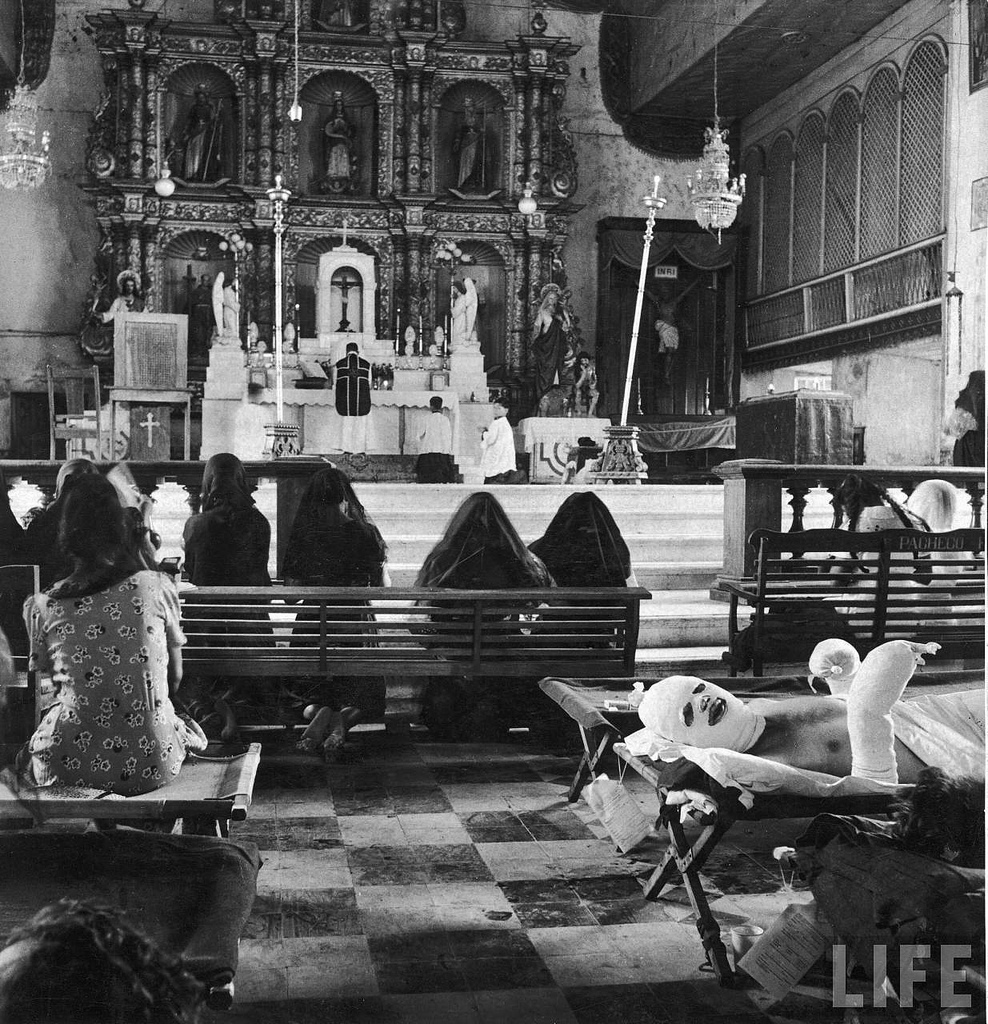
Mass in a cathedral while badly burned American officer lies swathed in bandages as he convalesces on cot, Leyte, Philippines, by W. Eugene Smith 1944 


“I wanted my pictures to carry some message against the greed, the stupidity and the intolerances that cause these wars.” 


Iwo Jima 1945

US Marine resting behind cart on rubble strewn street during battle to take Saipan from occupying Japanese forces, Saipan, by W. Eugene Smith 1944


A wounded soldier prays


This remarkable photograph was taken on assignment for LIFE (but not published in the magazine) and is one of the best examples of the narrative, documentary images W. Eugene Smith took between 1943 and 1945 while covering World War II in the Pacific. In this photograph, taken during the Battle of Okinawa, Smith demonstrated his ability to blend his strong compassion for humanity with superb aesthetic skills. In this carefully balanced and illuminated composition, he captured the strain, frustration, and terror of the soldiers'' situation. Bombarded by mortar shells and trapped by the fire of machine guns, they were unable to move forward or retreat.


U.S. soldier helping frightened civilians out of caves where they had hidden during battle of Saipan 1944.


Portrait of Smith ~ 1957


Portrait of Smith